Showing posts with label Civil / Political Dissent. Show all posts

Monday, June 18, 2012

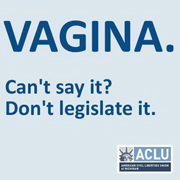
Vagina. Can't Say it? Don't Legislate It.

Because Freedom Can't Protect Itself


"I'm flattered you're all so interested in my vagina. But no means no."

With those words, Michigan state representative Lisa Brown told the Speaker of the House exactly what she thought of the vicious anti-choice measure he was trying to push through the legislature.

Here's what happened next. She was banned from speaking as the legislation moved forward. So was another female legislator, Rep. Barb Byrum, who reportedly shouted "vasectomy" out of turn.

They were silenced as the House of Representatives passed war on women legislation that could, among other things, shut down clinics that provide safe, legal abortions and end medication abortions throughout the state.

Silencing female legislators is a direct violation of their First Amendment rights and limits their ability to directly serve the people they represent. We can't let it stand.

Tell leaders of the Michigan Senate to protect freedom of speech and stop silencing women's voices.

Women deserve a seat at the table especially when legislation impacts our bodies and our health. Clearly we have much work to do if using an anatomically correct word causes such moral panic that it derails us from examining the larger issue: women are still being excluded from conversations about women's health.

We can't legislate on reproductive health if we aren't allowed to talk about our bodies. Stand with the ACLU in declaring: If you can't say it, don't legislate it. Remind leaders of the Michigan Senate to protect all of our First Amendment rights and defend women's reproductive health care.
Thanks for taking action,

Kary Moss
Executive Director, ACLU of Michigan
P.S. — This isn't the first time House majority leadership has denied women a voice on the issues that impact us the most. During a committee hearing last week, no woman — nearly 90 were present — was allowed to testify against the bills. Only women in support were given the time to speak out. We must send a message loud and clear: stop silencing women's voices.

Spread the Word
Help by sharing this campaign with friends.
  

Thursday, January 19, 2012

OCCUPY THE CORPORATIONS

Because corporations are not people and $$$ is not speech. Thanks to the original brave occupiers, more and more people know about the urgent need to pass a constitutional amendment overturning Citizens United vs. the Federal Election Commission (FEC), the devastating U.S. Supreme Court ruling that put our democracy up for sale by opening the floodgates of corporate campaign cash.

Go to http://democracyisforpeople.org/ for more info about how you can do your own demonstration this Saturday, January 21, 2012 (the second anniversary of the Citizens United ruling). Find an event already being organized near you here: http://pubc.it/FindJ21. Check out this video and set up your own page for your event http://www.youtube.com/watch?v=leXItJQldX4 then share it with us!

Follow @RuleByUs and checkout www.campaigncash.org for the latest Citizens United / #J21 / #campaigncash news and join the www.United4thePeople.org Coalition movement to pass a constitutional amendment.

Sunday, January 1, 2012

Occupy the Corporations: Stop the Impostors!

On January 21, as a part of our Nationwide Day of Action to overturn Citizens United v. FECand end corporate rule, Public Citizen is working with local activists to ‘apprehend’ corporate impostors posing as ‘people’ with the same constitutional rights as the rest of us.
We'll be exposing these impostors to the light of day in cities and towns throughout the nation, and together with local activists we'll be calling on their elected officials to support a constitutional amendment that would overturn Citizens United and end corporate domination of our democracy. Your action can be as simple as holding signs (we've got samples below!) and gathering petitions in front of a corporate target, or you can use one of the ideas we describe below.

Our Recommendation: Conduct an Investigation-- Expose the Impostors! 

 We believe that focusing our attention on a few important targets with outsized influence, those most responsible for the huge problems facing our society, will have the greatest impact. So on January 21, find a local branch of one of the corporate giants masquerading as "persons" and using their money to undermine our democratic process. Bank of America and Chevron are a couple of great examples.
We've come up with some ideas and tips to get you started in conducting your investigation and interviewing your corporate "person." Take a look at them and sign up today!
Other Recommendations for Actions
Citizens Posse: In 2010, a Citizens Posse was organized to effect a “citizens’ arrest” of greedy insurance companies that stood in the way of health care reform. They, and other short-sighted big corporations, are only empowered to effectively buy more influence by Citizens United!
Occupy the Kochs: Koch Industries (and the billionaire brothers behind it) are THE pre-eminent funders of faux-grassroots campaigns to gut vital environmental, consumer and worker protections, and the as politicians who support those efforts. Activists in the past have Quarantined the Kochsand held Guerrilla Drive-Ins outside their events and offices.
Corporate Crime Scene: Check out a recent action by Greenpeace in front of the US Chamber of Commerce. “Crime Scene: False Impersonation of a Human Being” has a nice ring to it, and regardless could make a nice sign for your event…
Musical Actions and Flash Mobs: Target got a lot of negative attention when it gave $150,000 to an extreme anti-worker, anti-gay candidate in Minnesota. Citizen activists responded with a spirited performance, Target Ain’t People.” The message applies to many other corporations, obviously.
Banner Hangs: Always an excellent way to get visibility. “ExxonMobil=Person?” for instance. Here’s agreat example from the Rainforest Action Network.
Occupy Corporate Offices: For the more daring among you, recent anti-foreclosure actions against Bank of America by New Bottom Line might be worth checking out.
Resources to help you plan your investigation: 
Here is a sample video of what your street theatre and rally could look like. We also encourage you to film your own street theatre prior to January 21 and share it with us (amendment@citizen.org) and your friends to build momentum for the day's actions.

Tuesday, December 13, 2011

Stop Indefinite Detention Bill!

The Senate has passed a version of the National Defense Authorization Act (NDAA) that includes a dangerous provision authorizing the U.S. military to pick up and imprison civilians — including Americans — without charge or trial, anywhere in the world, including in your own backyard. The provisions were negotiated by a few senators — in secret — and without proper Congressional review. The House of Representatives earlier passed its own version of the NDAA that authorizes worldwide war, and worldwide indefinite detention, even within America itself. And now, the House and Senate are meeting in secret to write a final version and find a way to rush this outrageous affront to our constitutional rights to President Obama's desk.
Tell your members of Congress to vote NO on the NDAA if it contains indefinite detention without charge or trial or new worldwide war powers. Time is critical because these secret negotiators hope to jam the bill through Congress within a week or two.
PLEASE CLICK HERE TO SEND AN EMAIL TO YOUR LOCAL REPRESENTATIVE

Structural Violence

Draft 6/1/99
NOTE: This version may not precisely match the published version. For any
scholarly activity, obtain the published version.
By Deborah DuNann Winter and Dana C. Leighton
Copyright 1999 Deborah DuNann Winter and Dana C. Leighton

Direct violence is horrific, but its brutality usually gets our attention: we notice it, and often respond to it. Structural violence, however, is almost always invisible, embedded in ubiquitous social structures, normalized by stable institutions and regular experience. Structural violence occurs whenever people are disadvantaged by political, legal, economic or cultural traditions. Because they are longstanding, structural inequities usually seem ordinary, the way things are and always have been. The chapters in this section teach us about some important but invisible forms of structural violence, and alert us to the powerful cultural mechanisms that create and maintain them over generations. Structured inequities produce suffering and death as often as direct violence does, though the damage is slower, more subtle, more common, and more difficult to repair.

Globally, poverty is correlated with infant mortality, infectious disease, and shortened lifespans. Whenever people are denied access to societys resources, physical and psychological violence exists.

Johan Galtung originally framed the term structural violence to refer to any constraint on human potential due to economic and political structures (1969). Unequal access to resources, to political power, to education, to health care, or to legal standing, are forms of structural violence. When inner city children have inadequate schools while others do not, when gays and lesbians are fired for their sexual orientation, when laborers toil in inhumane conditions, when people of color endure environmental toxins in their
neighborhoods, structural violence exists. Unfortunately, even those who are victims of structural violence often do not see the systematic ways in which their plight is choreographed by unequal and unfair distribution of societys resources.

Structural violence is problematic in and of itself, but it is also dangerous because it frequently leads to direct violence. Those who are chronically oppressed are often, for logical reasons, those who resort to direct violence. For example, cross-national studies of murder have shown a positive correlation between economic inequality and homicide rates across 40 nations (Hansmann & Quigley, 1982; Unnithan & Whitt, 1992).

In the U.S., racial inequality in wealth is correlated with murder rates (Blau & Golden, 1986). Often elites must use direct violence to curb the unrest produced by structural violence. For example, during the 1980s, mean income disparity between whites and blacks in the same urban area predicted use of deadly force by police (Jacobs & O'Brien, 1998). Structural violence often requires police states to suppress resentments and social unrest. Huge income disparities in many Latin American countries are protected by correspondingly huge military operations, which in turn drain resources away from social programs and produce even more structural violence.

Organized armed conflict in various parts of the world is easily traced to structured inequalities. Northern Ireland, for example, has been marked by economic disparities between Northern Irish Catholics-- who have higher unemployment rates and less formal education--and Protestants (Cairns & Darby, 1998). In Sri Lanka, youth unemployment and underemployment exacerbates ethnic conflict (Rogers, Spencer & Uyangoda, 1998). In Rwanda, huge disparities between the Hutu and Tutsies eventually led to ethnic massacres.

While structural violence often leads to direct violence, the reverse is also true, as brutality often terrorizes bystanders, who then become unwilling or unable to confront social injustice. Increasingly, civilians pay enormous costs of war through death and devastation of neighborhoods and ecosystems. Ruling elites rarely suffer from armed conflict as much as civilian populations do, who endure decades of poverty and disease in war-torn societies.

When social inequities are noticed, attempts are made to rationalize and understand them. Unfortunately, one outcome of this process is to assume that victims must in some way deserve their plight. But certainly it is easy to see that young children do not deserve to be victims of structural violence. The chapters in this section help us see the often invisible effects of structural violence, and the two first chapters focus on its effects on children. In their chapter The War Close to Home: Children and Violence in theUnited States, Kathleen Kostelny and James Garbarino describe the chronic violencewhich children in Chicago and other urban areas of the United States endure, often paralleling that experienced by children who live in countries at war. The authors examine myriad environmental risk factors, including family violence, parental depression, media violence, and firearm accessibility, which produce violent environments for children.
Children who endure these environments often become battle weary, numb, hopeless,and/or morally impaired. The authors describe how community and family support mechanisms must be built to mitigate these risks. For example, home visitation and early childhood education programs provide crucial community support.


While Kostelny and Garbarino focus on community intervention techniques, Milton Schwebel and Daniel Christie extend this discussion by examining the economic and psychological structures which impair at-risk children. In their article Children and Structural Violence, the authors explicate how children living in poverty experience diminished intellectual development because parents are too overwhelmed to be able to
provide crucial linguistic experiences. In the United States in particular, but throughout the world, children who are deprived of close bonds with adults and intellectual mediation which caretakers provide, are disadvantaged for the rest of their lives. Schwebel and Christies discussion concludes that economic structures must provide parents with living wage employment, good prenatal medical care, and high quality child care, if we are to see the next generation develop into the intelligent and caring citizens needed to
create a peaceful world.

If children are often the invisible and innocent victims of societys structural violence, so are their mothers. Diane Mazurana and Susan McKays Women, Girls, and Structural Violence discusses the many ways in which global sexism systematically denies girls and women access to resources. From health care and food, to legal standing and political power, females get less than males in every country on the planet. Yet we often do not notice sex-based injustice because we are so accustomed to seeing males with more power, prestige, and status than women. Mazurana and McKay argue that patriarchybased structural violence will not be redressed until women are able to play more active roles making decisions about how resources are distributed.

Patriarchal values also drive excessive militarism, as Deborah Winter, Marc Pilisuk, Sara Houck and Matthew Lee argue in their chapter, Understanding Militarism: Money, Masculinity, and the Search for the Mystical. The authors illuminate how socieites make soldiering a male rite of passage and proof of manhood, thereby showing the close link between militarism and masculinity. Militarization is also deeply rooted in spiritual motives, as men attempt to experience mystical sacrifice through war. Both masculinism
and mysticism drive military expenditures beyond rational ends, and produce great structural violence to those (usually women and children) whose human needs for adequate food, health care, and education go unmet because arms are bought instead. In addition, market forces fuel arms production and distribution throughout the world; half the worlds countries spend more on arms than health and education combined.
The global economy that drives weapons production and excessive militarization produces structural violence on a planetary scale, especially in developing countries, as Marc Pilisuk argues in his chapter Globalism and Structural Violence. As global markets grow, income disparity increases around the world. Relaxed trade regulations and increased communication networks are creating powerful multinational conglomerates that derive huge profits off under-paid laborers in developing countries. The result is horrific structural violence to workers who toil under brutal conditions. Globalism also produces a mono-culture, in which people throughout the world learn that the good life consists of convenience products, western dress, and western values of individuality and consumerism. The seduction of western norms is disintegrating traditional societies which in the past provided meaning and care for its members. Pilisuk argues that nongovernmental organizations at the local level must work to reclaim workers dignity and
neighborhoods.

The invisibility of injustice to laborers in the global market economy parallels the invisibility of injustice to indigenous people, the focus of Brinton Lykes chapter, Human Rights Violations as Structural Violence. Here Lykes argues for the expansion of human rights beyond the traditionally conceived civic and political realms, to include social, cultural and indigenous rights, which guarantee people their traditional culture and relationship with their land. She explicates two case studies, in Guatemala and Argentina,in which indigenous people are healing and reclaiming their cultural identities. Lykes discussion helps us see the limitations of psychology as it is traditionally conceived, that is, the study of individuals and their responses to their environments. For Lykes, as well as an increasing number of post-modern psychologists, the collective meanings of human experience-- human meaning that is embedded in particular cultures, neighborhoods, and placescan no longer be ignored. The individual cannot be our only focus.

Lykes call to examine and work with the collective meanings parallels the focus of this section on structural violence, in that both concepts force us to examine the political and economic institutions which psychologists typically ignore. In this respect, the thinking in both sections 2 (Structural Violence) and 4 (Peace Building) of this book go beyond traditional psychology, and force us to examine the sociological, economic, political, and spiritual dimensions of violence and peace.

Finally, to recognize the operation of structural violence forces us to ask questions about how and why we tolerate it, questions which often have painful answers for the privileged elite who unconsciously support it. A final question of this section is how and why we allow ourselves to be so oblivious to structural violence. Susan Opotow offers an intriguing set of answers, in her article Social Injustice. She argues that our normal perceptual/cognitive processes divide people into in-groups and out-groups. Those outside our group lie outside our scope of justice. Injustice that would be instantaneously confronted if it occurred to someone we love or know is barely noticed if it occurs to strangers or those who are invisible or irrelevant. We do not seem to be able to open our minds and our hearts to everyone, so we draw conceptual lines between those who are in and out of our moral circle. Those who fall outside are morally excluded, and become either invisible, or demeaned in some way so that we do not have to acknowledge the injustice they suffer. Moral exclusion is a human failing, but Opotow argues convincingly that it is an outcome of everyday social cognition. To reduce its nefarious effects, we must be vigilant in noticing and listening to oppressed, invisible, outsiders.


Inclusionary thinking can be fostered by relationships, communication, and appreciation of diversity.
Like Opotow, all the authors in this section point out that structural violence is not inevitable if we become aware of its operation, and build systematic ways to mitigate its effects. Learning about structural violence may be discouraging, overwhelming, or maddening, but these papers encourage us to step beyond guilt and anger, and begin to think about how to reduce structural violence. All the authors in this section note that the same structures (such as global communication and normal social cognition) which feed structural violence, can also be used to empower citizens to reduce it. In the long run, reducing structural violence by reclaiming neighborhoods, demanding social justice and living wages, providing prenatal care, alleviating sexism, and celebrating local cultures, will be our most surefooted path to building lasting peace.

References:
Blau, P.M. & Golden, R.M. (1986). Metropolitan structure and criminal violence.
Sociological Quarterly, 27(1), 15-26.
Cairns, E. & Darby, J., (1998). The conflict in Northern Ireland: Causes, consequences,
and controls. American Psychologist, 53(7), 754-760.
Galtung, J. (1969). Violence, peace and peace research. Journal of Peace Research, 6
(3), 167-191.
Hansmann, H.B. & Quigley, J.M. (1982). Population heterogeneity and the sociogenesis
of homicide. Social Forces, 61(2), 206-204.
Jacobs, D & O'Brien, R.M. (1998). The determinants of deadly force: A structural
analysis of police violence. American Journal of Sociology, 103(4), 837-862.
Rogers, J.D., Spencer, J., & Uyangoda, J. (1998). Sri Lanka: Political violence and
ethnic conflict. American Psychologist, 53(7), 771-777.
Unnithan, N.P. & Whitt, H.P. (1992). Inequality, economic development and lethal
violence: A cross-national analysis of suicide and homocide. International Journal
of Comparative Sociology, 33(3-4), 182-196

Friday, November 4, 2011

These are the Times

By John Perkins
“A man in debt is so far a slave.” (Ralph Waldo Emerson)
My job as an economic hit man during the 1970s was to enslave nations that had resources our corporations coveted by burdening them with debts they could never repay. We then demanded that they sell those resources cheap, without social or environmental regulations, to our corporations.
It was an incredibly successful strategy. In essence it created the world’s first truly global empire and the first one that was not built primarily through military occupations. It also transformed geo-politics. The power of elected officials was usurped by those who sit at the top of the multinational corporations (the ‘corporatocracy’).
This success led to the realization that similar strategies could be applied in the United States in order to emasculate a population that was exerting its democratic rights in ways that threatened the corporatocracy  – forcing an end to the highly profitable Vietnam War, demanding racial and gender equality, increasing social security, Medicare, education, and other services.
By 1980, the Reagan administration understood that its most effective weapon to protect corporations against labor movements was debt. Borrowers were deceived into believing that they were paying low interest rates when in fact balloon payments, adjustable rate mortgages, and other technically complex packages resulted in higher overall rates that made it increasingly difficult to break the shackles of debt.
This story continued. Regulations that protected our rights were demolished. New wars erupted. Family businesses were wiped out by the unfair practices of huge chains. The media was commandeered by a handful of giant conglomerates.  Unemployment, poverty and foreclosures escalated. The upward trend line of a growing and prospering middle class plummeted.
We the people fell into a trance of lethargy.
Until now!
We have finally realized that we are serfs  of a system that reflects the feudal Middle Ages. Modern-day lords of the castle, the corporatocracy had convinced us – we who live outside the walls and supply all the food and conveniences for them – that if we didn’t pay our “debts” and service their every desire we would be raped and pillaged by soldiers from neighboring castles. But we are no longer buying their lies. 
Across this planet, we have marched into the courtyards of those castles with the message that we are no longer blind. We will not be hoodwinked by their false promises or by their fear tactics. The Occupy movement spans seven continents. Participation expands at seemingly exponential rates, online as well as at the front lines. It is the largest mass protest since those against the Vietnam War – and may well turn into the largest in human history.
Those at Wall St. and in the financial and political system who operate above the law without remorse or penalty and have believed for a long time that workers saddled with debt will not strike, quit, or demand justice, are hearing our message.
There are those among us who express skepticism. They say nothing will come of this. They are wrong. The Occupy movement has already changed the world and we must continue forward. With the recent arrests and uptake of policing these events, we must pay attention that our democracy and free speech is at threat.
The corporatoctacy are striking back. They are writing new laws forbidding us to assemble in places like Wall Street. They are attempting to censor the Internet (as they did in Egypt). They will come up with schemes we can’t even imagine.
Each time they do this we must utilize their energy to inspire and empower us further.  Coming from a place where we know we are right, we will employ the aikido of love, compassion, and cooperation to keep expanding our energy, our resolve, and our creative responses.
At a time during the American Revolution, when things looked very dire, Tom Paine wrote:
"These are the times that try men's souls. The summer soldier and the sunshine patriot will, in this crisis, shrink from the service of their country; but he that stands by it now, deserves the love and thanks of man and woman. Tyranny, like hell, is not easily conquered; yet we have this consolation with us, that the harder the conflict, the more glorious the triumph. . .A generous parent should say, "If there must be trouble, let it be in my day, that my child may have peace." . . . 'Tis the business of little minds to shrink; but he whose heart is firm, and whose conscience approves his conduct, will pursue his principles unto death. . . By perseverance and fortitude we have the prospect of a glorious issue."
This is another of those times. Our souls are being tried. This is our opportunity to stand firm, to show our perseverance and fortitude. This is a time our children and grandchildren will sing about. Their ballads will praise us for bringing them the world we all deserve..
END
John
John Perkins
New York Times bestselling author

Please subscribe to my newsletter at
http://www.johnperkins.org .
Hoodwinked: An Economic Hit Man Reveals Why the World Financial Markets IMPLODED-and What We Need to Do to Remake Them is now available in paperback and I hope you’ll support its release -  http://tinyurl.com/3gj5mxu .

Tuesday, October 4, 2011

Assassinating Awlaki


The Day America Died             

by PAUL CRAIG ROBERTS

 Oct 4, 2011 

****THIS ARTICLE IS FROM http://www.counterpunch.org

Please subscribe to CounterPunch

September 30, 2011 was the day America was assassinated.
Some of us have watched this day approach and have warned of its coming, only to be greeted with boos and hisses from “patriots” who have come to regard the US Constitution as a device that coddles criminals and terrorists and gets in the way of the President who needs to act to keep us safe.
In our book, The Tyranny of Good Intentions, Lawrence Stratton and I showed that long before 9/11 US law had ceased to be a shield of the people and had been turned into a weapon in the hands of the government.  The event known as 9/11 was used to raise the executive branch above the law. As long as the President sanctions an illegal act, executive branch employees are no longer accountable to the law that prohibits the illegal act. On the president’s authority, the executive branch can violate US laws against spying on Americans without warrants, indefinite detention, and torture and suffer no consequences.
Many expected President Obama to re-establish the accountability of government to law.  Instead, he went further than Bush/Cheney and asserted the unconstitutional power not only to hold American citizens indefinitely in prison without bringing charges, but also to take their lives without convicting them in a court of law.  Obama asserts that the US Constitution notwithstanding, he has the authority to assassinate US citizens, who he deems to be a “threat,” without due process of law.
In other words, any American citizen who is moved into the threat category has no rights and can be executed without trial or evidence.
On September 30 Obama used this asserted new power of the president and had two American citizens, Anwar Awlaki and Samir Khan murdered.  Khan was a wacky character associated with Inspire Magazine and does not readily come to mind as a serious threat.
Awlaki was a moderate American Muslim cleric who served as an advisor to the US government after 9/11 on ways to counter Muslim extremism.  Awlaki was gradually radicalized by Washington’s use of lies to justify military attacks on Muslim countries. He became a critic of the US government and told Muslims that they did not have to passively accept American aggression and had the right to resist and to fight back. As a result Awlaki was demonized and became a threat.
All we know that Awlaki did was to give sermons critical of Washington’s indiscriminate assaults on Muslim peoples. Washington’s argument is that his sermons might have had an influence on some who are accused of attempting terrorist acts, thus making Awlaki responsible for the attempts.
Obama’s assertion that Awlaki was some kind of high-level Al Qaeda operative is merely an assertion.  Jason Ditz on antiwar.com  concluded that the reason Awlaki was murdered rather than brought to trial is that the US government had no real evidence that Awlaki was an Al Qaeda operative.
Having murdered its critic, the Obama Regime is working hard to posthumously promote Awlaki to a leadership position in Al Qaeda.  The presstitutes and the worshippers  of America’s First Black President have fallen in line and regurgitated the assertions that Awlaki was a high-level dangerous Al Qaeda terrorist. If Al Qaeda sees value in Awlaki as a martyr, the organization will give credence to these claims. However, so far no one has provided any evidence. Keep in mind that all we know about Awlaki is what Washington claims and that the US has been at war for a decade based on false claims.
But what Awlaki did or might have done is beside the point.  The US Constitution requires that even the worst murderer cannot be punished until he is convicted in a court of law. When the American Civil Liberties Union challenged in federal court Obama’s assertion that he had the power to order assassinations of American citizens, the Obama Justice (sic) Department argued that Obama’s decision to have Americans murdered was an executive power beyond the reach of the judiciary.
In a decision that sealed America’s fate, federal district court judge John Bates ignored the Constitution’s requirement that no person shall be deprived of life without due process of law and dismissed the case, saying that it was up to Congress to decide. Obama acted before an appeal could be heard, thus using Judge Bates’ acquiescence  to establish the power and advance the transformation of the president into a Caesar that began under George W. Bush.
Attorneys Glenn Greenwald and Jonathan Turley  point out that Awlaki’s assassination terminated the Constitution’s restraint on the power of government. Now the US government not only can seize a US citizen and confine him in prison for the rest of his life without ever presenting evidence and obtaining a conviction, but also can have him shot down in the street or blown up by a drone.
Before some readers write to declare that Awlaki’s murder is no big deal because the US government has always had people murdered, keep in mind that CIA assassinations were of foreign opponents and were not publicly proclaimed events, much less a claim by the president to be above the law. Indeed, such assassinations were denied, not claimed as legitimate actions of the President of the United States.
The Ohio National Guardsmen who shot Kent State students as they protested the US invasion of Cambodia in 1970 made no claim to be carrying out an executive branch decision. Eight of the guardsmen were indicted by a grand jury.  The guardsmen entered a self-defense plea. Most Americans were angry at war protestors and blamed the students. The judiciary got the message, and the criminal case was eventually dismissed. The civil case (wrongful death and injury) was settled for $675,000 and a statement of regret by the defendants.
The point isn’t that the government killed people.  The point is that never prior to President Obama has a President asserted the power to murder citizens.
Over the last 20 years, the United States has had its own Mein Kampftransformation. Terry Eastland’s book, Energy in the Executive: The Case for the Strong Presidency, presented ideas associated with the Federalist Society, an organization of Republican lawyers that works to reduce legislative and judicial restraints on executive power. Under the cover of wartime emergencies (the war on terror), the Bush/Cheney regime employed these arguments to free the president from accountability to law and to liberate Americans from their civil liberties. War and national security provided the opening for the asserted new powers, and a mixture of fear and desire for revenge for 9/11 led Congress, the judiciary, and the people to go along with the dangerous precedents.
As civilian and military leaders have been telling us for years, the war on terror is a 30-year project.  After such time has passed, the presidency will have completed its transformation into Caesarism, and there will be no going back.
Indeed, as the neoconservative “Project For A New American Century” makes clear, the war on terror is only an opening for the neoconservative imperial ambition to establish US hegemony over the world.
As wars of aggression or imperial ambition are war crimes under international law, such wars require doctrines that elevate the leader above the law and the Geneva Conventions, as Bush was elevated by his Justice (sic) Department with minimal judicial and legislative interference.
Illegal and unconstitutional actions also require a silencing of critics and punishment of those who reveal government crimes.  Thus Bradley Manning has been held for a year, mainly in solitary confinement under abusive conditions, without any charges being presented against him. A federal grand jury is at work concocting spy charges against Wikileaks’ founder Julian Assange.  Another federal grand jury is at work concocting terrorists charges against antiwar activists.
“Terrorist” and “giving aid to terrorists” are increasingly elastic concepts. Homeland Security has declared that the vast federal police bureaucracy has shifted its focus from terrorists to “domestic extremists.”
It is possible that Awlaki was assassinated because he was an effective critic of the US government.  Police states do not originate fully fledged. Initially, they justify their illegal acts by demonizing their targets and in this way create the precedents for unaccountable power. Once the government equates critics with giving “aid and comfort” to terrorists, as they are doing with antiwar activists and Assange, or with terrorism itself, as Obama did with Awlaki, it will only be a short step to bringing accusations against Glenn Greenwald and the ACLU.
The Obama Regime, like the Bush/Cheney Regime, is a regime that does not want to be constrained by law.  And neither will its successor. Those fighting to uphold the rule of law, humanity’s greatest achievement, will find themselves lumped together with the regime’s opponents and be treated as such.
This great danger that hovers over America is unrecognized by the majority of the people. When Obama announced before a military gathering his success in assassinating an American citizen, cheers erupted.  The Obama regime and the media played the event as a repeat of the (claimed) killing of Osama bin Laden.  Two “enemies of the people” have been triumphantly dispatched. That the President of the United States was proudly proclaiming to a cheering audience sworn to defend the Constitution that he was a murderer and that he had also assassinated the US Constitution is extraordinary evidence that Americans are incapable of recognizing the threat to their liberty.
Emotionally, the people have accepted the new powers of the president.  If the president can have American citizens assassinated, there is no big deal about torturing them.  Amnesty International has sent out an alert that the US Senate is poised to pass legislation that would keep Guantanamo Prison open indefinitely and that Senator Kelly Ayotte (R-NH) might introduce a provision that would legalize “enhanced interrogation techniques,” an euphemism for torture.
Instead of seeing the danger, most Americans will merely conclude that the government is getting tough on terrorists, and it will meet with their approval. Smiling with satisfaction over the demise of their enemies, Americans are being led down the garden path to rule by government unrestrained by law and armed with the weapons of the medieval dungeon.
Americans have overwhelming evidence from news reports and YouTube videos of US police brutally abusing women, children, and the elderly, of brutal treatment and murder of prisoners not only in Abu Ghraib, Guantanamo, and secret CIA prisons abroad, but also in state and federal prisons in the US. Power over the defenseless attracts people of a brutal and evil disposition.
A brutal disposition now infects the US military. The leaked video of US soldiers delighting, as their words and actions reveal, in their murder from the air of civilians and news service camera men walking innocently along a city street shows soldiers and officers devoid of humanity and military discipline.  Excited by the thrill of murder, our troops repeated their crime when a father with two small children stopped to give aid to the wounded and were machine-gunned.
So many instances: the rape of a young girl and murder of her entire family; innocent civilians murdered and AK-47s placed by their side as “evidence” of insurgency; the enjoyment experienced not only by high school dropouts from torturing they-knew-not- who in Abu Ghraib and Guantanamo, but also by educated CIA operatives and Ph.D. psychologists.  And no one held accountable for these crimes except two lowly soldiers prominently featured in some of the torture photographs.
What do Americans think will be their fate now that the “war on terror” has destroyed the protection once afforded them by the US Constitution?  If Awlaki really needed to be assassinated, why did not President Obama protect American citizens from the precedent that their deaths can be ordered without due process of law by first stripping Awlaki of his US citizenship?  If the government can strip Awlaki of his life, it certainly can strip him of citizenship.  The implication is hard to avoid that the executive branch desires the power to terminate citizens without due process of law.
Governments escape the accountability of law in stages.  Washington understands that its justifications for its wars are contrived and indefensible. President Obama even went so far as to declare that the military assault that he authorized on Libya without consulting Congress was not a war, and, therefore, he could ignore the War Powers Resolution of 1973, a federal law intended to check the power of the President to commit the US to an armed conflict without the consent of Congress.
Americans are beginning to unwrap themselves from the flag. Some are beginning to grasp that initially they were led into Afghanistan for revenge for 9/11.  From there they were led into Iraq for reasons that turned out to be false. They see more and more US military interventions: Libya, Yemen, Somalia, Pakistan and now calls for invasion of Pakistan and continued saber rattling for attacks on Syria, Lebanon, and Iran.  The financial cost of a decade of the “war against terror” is starting to come home. Exploding annual federal budget deficits and national debt threaten Medicare and Social Security. Debt ceiling limits threaten government shut-downs.
War critics are beginning to have an audience.  The government cannot begin its silencing of critics by bringing charges against US Representatives Ron Paul and Dennis Kucinich.  It begins with antiwar protestors, who are elevated into “antiwar activists,” perhaps a step below “domestic extremists.”  Washington begins with citizens who are demonized Muslim clerics radicalized by Washington’s wars on Muslims. In this way, Washington establishes the precedent that war protestors give encouragement and, thus, aid, to terrorists.  It establishes the precedent that those Americans deemed a threat are not protected by law. This is the slippery slope on which we now find ourselves.
Last year the Obama Regime tested the prospects of its strategy when Dennis Blair, Director of National Intelligence, announced that the government had a list of American citizens that it was going to assassinate abroad.  This announcement, had it been made in earlier times by, for example, Richard Nixon or Ronald Reagan, would have produced a national uproar and calls for impeachment.  However, Blair’s announcement caused hardly a ripple.  All that remained for the regime to do was to establish the policy by exercising it.
Readers ask me what they can do.  Americans not only feel powerless, they are powerless.  They cannot do anything. The highly concentrated, corporate-owned, government-subservient print and TV media are useless and no longer capable of performing the historic role of protecting our rights and holding government accountable. Even many antiwar Internet sites shield the government from 9/11 skepticism, and most defend the government’s “righteous intent” in its war on terror. Acceptable criticism has to be couched in words such as “it doesn’t serve our interests.”
Voting has no effect. President “Change” is worse than Bush/Cheney. As Jonathan Turley suggests, Obama is “the most disastrous president in our history.” Ron Paul is the only presidential candidate who stands up for the Constitution, but the majority of Americans are too unconcerned with the Constitution to appreciate him.
To expect salvation from an election is delusional. All you can do, if you are young enough, is to leave the country. The only future for Americans is a nightmare.
Paul Craig Roberts was Assistant Secretary of the US Treasury, Associate Editor of the Wall Street Journal, and professor of economics in six universities. His latest book, HOW THE ECONOMY WAS LOST, was published by CounterPunch/AK Press. He can be reached at:PaulCraigRoberts@yahoo.com


Thursday, September 29, 2011

Wendell Potter

Everyone should know of Wendell Potter. If you do not, then I suggest clicking here to find out more about this man who has turned his back on the corporate-greed-death-machine that he use to work for.

Occupy Wall Street rediscovers the radical imagination

Article by David Graeber & The Guardian

Why are people occupying Wall Street? Why has the occupation –despite the latest police crackdown – sent out sparks across America, within days, inspiring hundreds of people to send pizzas, money, equipment and, now, to start their own movements called OccupyChicago, OccupyFlorida, in OccupyDenver or OccupyLA?
There are obvious reasons. We are watching the beginnings of the defiant self-assertion of a new generation of Americans, a generation who are looking forward to finishing their education with no jobs, no future, but still saddled with enormous and unforgivable debt. Most, I found, were of working-class or otherwise modest backgrounds, kids who did exactly what they were told they should: studied, got into college, and are now not just being punished for it, but humiliated – faced with a life of being treated as deadbeats, moral reprobates.
Is it really surprising they would like to have a word with the financial magnates who stole their future?
Just as in Europe, we are seeing the results of colossal social failure. The occupiers are the very sort of people, brimming with ideas, whose energies a healthy society would be marshaling to improve life for everyone. Instead, they are using it to envision ways to bring the whole system down.
But the ultimate failure here is of imagination. What we are witnessing can also be seen as a demand to finally have a conversation we were all supposed to have back in 2008. There was a moment, after the near-collapse of the world's financial architecture, when anything seemed possible.
Everything we'd been told for the last decade turned out to be a lie. Markets did not run themselves; creators of financial instruments were not infallible geniuses; and debts did not really need to be repaid – in fact, money itself was revealed to be a political instrument, trillions of dollars of which could be whisked in or out of existence overnight if governments or central banks required it. Even the Economist was running headlines like "Capitalism: Was it a Good Idea?"
It seemed the time had come to rethink everything: the very nature of markets, money, debt; to ask what an "economy" is actually for. This lasted perhaps two weeks. Then, in one of the most colossal failures of nerve in history, we all collectively clapped our hands over our ears and tried to put things back as close as possible to the way they'd been before.
Perhaps, it's not surprising. It's becoming increasingly obvious that the real priority of those running the world for the last few decades has not been creating a viable form of capitalism, but rather, convincing us all that the current form of capitalism is the only conceivable economic system, so its flaws are irrelevant. As a result, we're all sitting around dumbfounded as the whole apparatus falls apart.
What we've learned now is that the economic crisis of the 1970s never really went away. It was fobbed off by cheap credit at home and massive plunder abroad – the latter, in the name of the "third world debt crisis". But the global south fought back. The "alter-globalisation movement", was in the end, successful: the IMF has been driven out of East Asia and Latin America, just as it is now being driven from the Middle East. As a result, the debt crisis has come home to Europe and North America, replete with the exact same approach: declare a financial crisis, appoint supposedly neutral technocrats to manage it, and then engage in an orgy of plunder in the name of "austerity".
The form of resistance that has emerged looks remarkably similar to the old global justice movement, too: we see the rejection of old-fashioned party politics, the same embrace of radical diversity, the same emphasis on inventing new forms of democracy from below. What's different is largely the target: where in 2000, it was directed at the power of unprecedented new planetary bureaucracies (the WTO, IMF, World Bank, Nafta), institutions with no democratic accountability, which existed only to serve the interests of transnational capital; now, it is at the entire political classes of countries like Greece, Spain and, now, the US – for exactly the same reason. This is why protesters are often hesitant even to issue formal demands, since that might imply recognising the legitimacy of the politicians against whom they are ranged.
When the history is finally written, though, it's likely all of this tumult – beginning with the Arab Spring – will be remembered as the opening salvo in a wave of negotiations over the dissolution of the American Empire. Thirty years of relentless prioritising of propaganda over substance, and snuffing out anything that might look like a political basis for opposition, might make the prospects for the young protesters look bleak; and it's clear that the rich are determined to seize as large a share of the spoils as remain, tossing a whole generation of young people to the wolves in order to do so. But history is not on their side.
We might do well to consider the collapse of the European colonial empires. It certainly did not lead to the rich successfully grabbing all the cookies, but to the creation of the modern welfare state. We don't know precisely what will come out of this round. But if the occupiers finally manage to break the 30-year stranglehold that has been placed on the human imagination, as in those first weeks after September 2008, everything will once again be on the table – and the occupiers of Wall Street and other cities around the US will have done us the greatest favour anyone possibly can. 

Pilots Stage Protest

***This article is from MailOnline.com


Wall Street saw yet another surge in protesters today - as hundreds of Continental and United Airlines pilots demonstrated in New York City's financial district.

Over 700 hundred activists, represented by the Air Line Pilots Association (ALPA) carriers, took their grievances to the streets as they protested for wages and benefits in light of a stalled merger between the airlines.

The demonstration coincided with the 11th straight day the Occupy Wall Street encampment, which has seen thousands of demonstrators descend onto downtown Manhattan - and hundreds arrested.


Continental's ALPA unit announced the union rally, saying the company needed to 'get serious' about negotiating a joint contract.

United officials have said they want a fair contract and have been meeting with pilots from both unions since August 2010, arguing that none of the major sections dealing with work rules, pay, scope/job protection or retirement/benefits has been resolved.

Management wanted a deal in place by the end of 2011, but said over the summer the target would be missed. No new date has been set.


Without a joint contract that merges seniority and duties, the carrier cannot achieve the full measure of cost and revenue benefits forecast as part of the merger. 

The announcement came after pilots at United Airlines asked a federal judge on Monday to halt integration with Continental Airlines, saying the company is moving too fast in its bid to merge operations fully.

The United chapter of the Air Line Pilots Association (ALPA), which filed suit in the U.S. District Court for the Eastern District of New York, sought a stay of Friday's deadline to complete the next phase of training and begin new procedures.

The union said the proposed level and timeline of training necessary for United Continental Holdings Inc (UAL.N) to earn single operating authority from Federal Aviation Administration (FAA) is inadequate.

FAA clearance is the final step in the merger to create the world's biggest airline. The deal closed last year.

Pilots contend interrupting the deadline for new procedures would allow the union and management to either negotiate a resolution or arbitrate the dispute.

A court hearing in Brooklyn is scheduled for Wednesday.

The union said most of the training changes involve United pilots, who are adopting many of Continental's cockpit procedures.

United said the suit was without merit and was a shameful attempt to influence negotiations on a joint contract between United and Continental pilots.

Read more: http://www.dailymail.co.uk/news/article-2042680/Wall-Street-Protests-Continental-United-Airlines-pilots-fed-bosses.html#ixzz1ZMRyQbsf

Monday, August 8, 2011

Joint Solidarity Statement by US Day of Rage and the October2011 Movement:


By Margaret Flowers - Posted on 08 August 2011

Our struggles are interconnected and so we organize in mutual support and solidarity with each other.

The October2011 Movement is planning an occupation and nonviolent resistance actions in Washington, DC starting on October 6, 2011. This date marks the 10-year anniversary of the U.S. war in Afghanistan and the first week of the new federal budget which provides unlimited funding for war, tax breaks for the wealthy and austerity for human services.
Thousands of people have pledged to gather in Freedom Plaza beginning on that day to nonviolently disrupt the disloyal, incompetent, and corrupt special interests which have usurped our nation’s civil and military power, spawning a host of threats to our liberty, lives and national security.  
The October2011 Movement protests corporatism and militarism because they prevent solutions to our current crises which would create a more peaceful, just and sustainable world from being implemented. Instead concentrated corporate interests rule our elections and political process so that wealth continues to be funneled to the top 1%.
US Day of Rage is calling for free and fair elections, not elections manipulated by the economic elite, special interests, or the corporate media, where choices are limited to two corrupt political parties and candidates.  US Day of Rage is organizing with OccupyWallStreet to create a tent city in the financial district of New York beginning on September 17. October2011 and OccupyWallStreet have endorsed each others’ actions.
Legitimate government is born of the people expressed by its citizens in free and fair elections. It does not spring from a tyranny of special interests, crony capitalism, or a system or ideology that runs counter to the aims of life.
Free and fair elections inspire good citizenship and public service, because they engage the intelligence and genuine good will of the American people.  They produce the kind of stewardship our nation desperately needs, because they ensure that citizens can influence their destiny, and make genuine contributions to society unlike our present system where the government moves in directions the majority of Americans oppose putting the profits of campaign donors ahead of the wishes of the American people.
Free and fair elections are steps towards remediating the myriad ills and abuses of a corrupt and illegitimate government, which preys on the resources and spirits of citizens, and violates rights of the planet, other peoples and nations.
The October2011 Movement and US Day of Rage know that abuses of the people and planet will end when we take unified and persistent action. We stand in solidarity with each other and with the growing nonviolent movements around the nation and world to call for democratization of our society.
October2011 Movement, october2011.org
Margaret Flowers, 202-688-2444 
Kevin Zeese 301-996-6582/ 518-543-6920

US Day of Rage, usdayofrage.org
Alexa O'Brien, 917 568 3966
***NOTE***
THIS LETTER IS FROM: OCTBER2011.ORG
PLEASE SUPPORT BY CLICKING HERE